The Fridge Border: Eating Well in a Kitchen You Share
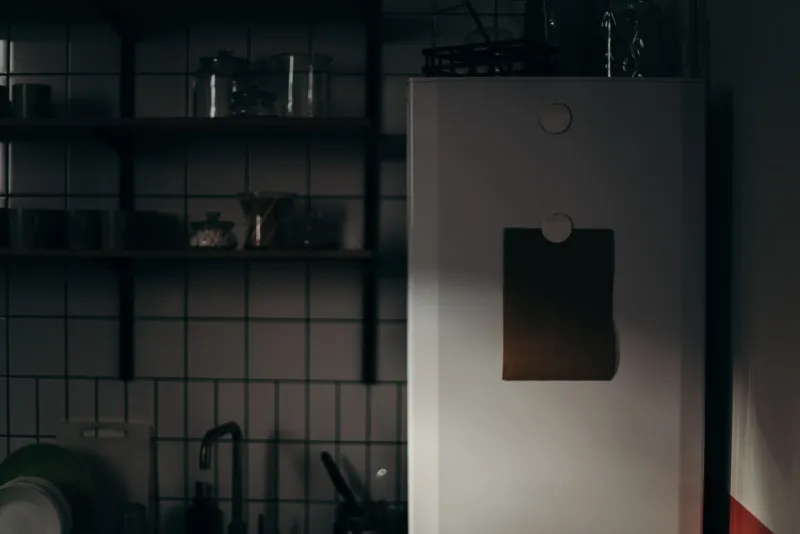
A shared kitchen is rarely the problem. The problem is the fog around it: whose hummus is that, why is the hob still wearing last night's pasta, and who used the last of the milk without saying. You do not need a perfect setup to eat well in a house-share. You need a workable border, a couple of meals that behave themselves, and a lunch plan that survives a messy Tuesday.
Draw a border, not a battle line
The most useful thing you can do in a shared fridge is make your food obvious. Not precious. Obvious. A shelf of your own, or a labelled tub inside a shared shelf, cuts down on the low-level friction that makes people stop cooking altogether.
Masking tape and a marker are enough. Write your name, or draw a small symbol if you share with someone who ignores names. Keep your chopped veg, your leftovers and your lunch components in one place so you can see what you have got. If space is tight, use a clear box rather than scattering things across three shelves. A box says this is a portion of the fridge, not a claim on the whole kitchen.
The same goes for the cupboard. One basket for your dry goods — rice, lentils, tinned tomatoes, oats — stops your food disappearing into the communal black hole. It also makes your weekly shop easier, because you can see the gap before you buy another bag of pasta you do not need.
This is not about being territorial. It is about removing ambiguity. Most flatmates are not trying to steal your lunch; they are tired and half-looking. Make your stuff findable and you remove one small reason for a row.
The two-pot rule
Shared kitchens reward repetition more than ambition. If you can cook one decent thing that stretches into two or three meals, you have solved more than a recipe: you have solved the question of what happens when the kitchen is occupied at 6pm and you are hungry at 7pm.
Think along the lines of a lentil bolognese, a chilli, a dhal, or a traybake of chicken and vegetables. These are low-conflict meals. They use one pot or one oven shelf, they reheat well, and they do not demand that you stand over the hob for an hour while someone else waits to boil rice.
Cook when the kitchen is quiet, if you can. Sunday evening, or a late Wednesday when the flat has gone to bed. Portion what you have made into containers you are not too attached to, label them, and put half in the freezer if there is room. The freezer is your second shelf. A couple of frozen portions are a buffer against the nights when the sink is full and the hob is wearing a crust.
A traybake is a particularly good shared-kitchen meal because it asks for one shelf and then leaves you alone. Chop potatoes, onions, peppers, whatever is going soft, add chicken thighs or chickpeas, oil, salt, paprika, and let the oven do the work. It is not glamorous. It is reliable. In a house-share, reliable wins.
Keep a no-cook fallback
There will be days when the kitchen is not usable in the way you planned. Someone is cooking a big meal, the washing-up has reached the point of architecture, or the bin is full and nobody has taken it out. Do not turn that into a reason to skip lunch and spend the afternoon grazing on biscuits.
Keep a small fallback that does not need the hob. A tub of washed salad, a tin of chickpeas, a wholemeal pitta, a jar of olives, some feta or cottage cheese. Or couscous made with just-boiled kettle water, frozen sweetcorn stirred through, and a tin of tuna or beans. It is not a blog-worthy bowl. It is lunch, and it keeps you level.
If you work from home in a shared flat, this matters more. The kitchen is often at its worst at midday, exactly when you need it most. A fallback lunch is not a failure of planning. It is the plan.
The 9pm reset
Washing-up rotas have a habit of collapsing because they are too ambitious. A full rota with names and days looks organised for about a week. Then someone works late, someone else has guests, and the whole thing turns into a silent competition about who is more tired.
Try something smaller. A ten-minute reset at 9pm: whoever is around wipes the surfaces, stacks the dishwasher or washes the pans, and takes the bin out if it is full. Not a deep clean. Not a moral judgement. Just a reset so the kitchen is usable in the morning.
If you are the one who cooks most, say so plainly and offer a trade. I will cook on Tuesday if you clear the hob and empty the bin. That is not a confrontation; it is a small piece of domestic admin. Reliability buys goodwill in a way that passive-aggressive notes never do.
Shop for the kitchen you actually have
It is easy to buy for the kitchen you wish you had: a big fridge, a quiet hob, a cupboard that is not already full of someone else's protein powder. Buy for the one you have. That means a few shelf-stable backups, a bag of frozen peas, tinned tomatoes, rice, oats, and a short list of meals you can make with one ring and one shelf.
Pasta with frozen veg and pesto. Rice with tinned fish and cucumber. An omelette with whatever is in the drawer. A jacket potato if the oven is free, or a microwave one if it is not. These are not compromises. They are the ordinary food that keeps a shared house running.
A shared kitchen will never be entirely yours. That is the deal. But a labelled shelf, two meals that stretch, and a lunch that does not depend on a clean hob will get you through most weeks. Not perfect. Just a better routine, and better days.