The Potato That Carries Dinner: A Weeknight Jacket Rotation for Dark Evenings
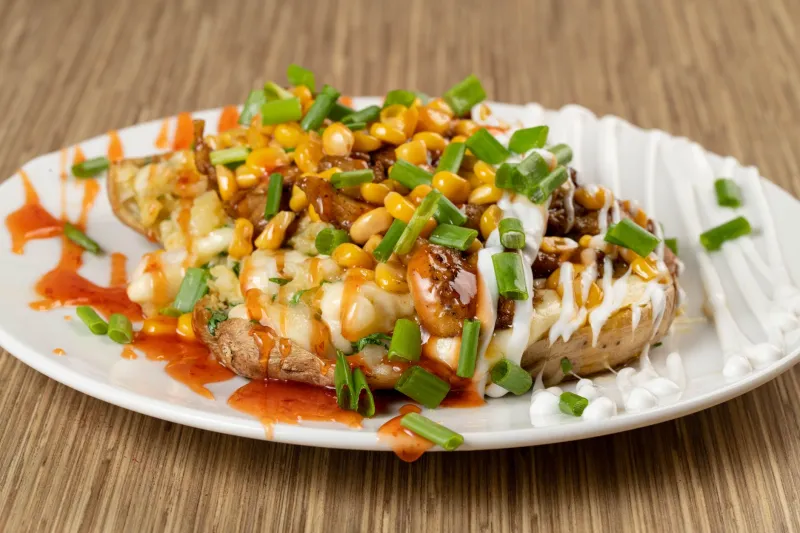
Jacket potatoes have a reputation problem. They turn up next to something else, or they arrive as a cheese-and-beans afterthought. That is a shame, because on a cold November evening a jacket potato can be the whole dinner: hot, cheap, filling and almost entirely hands-off. It is not another pasta bake. It is a potato doing a proper job.
The trick is to stop treating the topping as a garnish and start treating it as the rest of the plate. Once you do that, the jacket potato becomes one of the most useful weeknight dinners in the rotation. It suits a late return from work, a fridge that is half empty, and a general reluctance to stand at the hob for forty minutes.
Start with a potato that is actually cooked
A good jacket potato needs two stages. First, soften the inside. Then, crisp the skin. Skip the second stage and you get a steamed potato with a leathery jacket. Skip the first and you are waiting an hour for dinner.
Take a decent-sized floury potato. Maris Piper, King Edward, or whatever loose baking potatoes your supermarket has. Prick it a few times with a fork. Microwave on high for 8 to 12 minutes, depending on size, turning halfway. It should feel soft when you squeeze it with a tea towel. Then rub the skin with a little oil and salt and put it in a hot oven, around 200C fan, for 15 to 20 minutes. That is enough to dry the skin and give it a proper crisp edge.
If you have an air fryer, it will do the second stage happily at around 200C for 10 to 15 minutes. Either way, the microwave does the heavy lifting. The oven makes it taste like a jacket potato rather than a boiled potato with ambitions.
The topping rule: protein, veg, something fresh
A jacket potato is a carbohydrate base. That is fine. It is not the whole meal on its own. The topping needs to bring protein, vegetables and something sharp or fresh so the whole thing does not taste like a beige cloud.
This is not a strict formula. It is a nudge. If you have beans, cheese and a handful of rocket, you are there. If you have tuna, sweetcorn and cucumber, you are there. If you have leftover chilli and a spoon of yoghurt, you are there. The point is to build a plate, not to decorate a potato.
Four toppings for the rotation
1. Beans, cheddar and quick-pickled onion. Warm a tin of baked beans with a pinch of smoked paprika if you have it. Grate mature cheddar. Slice a red onion thinly, cover it with vinegar and a pinch of salt while the potato cooks. The onion gives a sharp, fresh edge that stops the beans and cheese feeling heavy. Add a handful of salad leaves if they are in the fridge. This is the classic, but with the volume turned up.
2. Tuna, sweetcorn and cucumber. Mix a tin of drained tuna with a spoon of yoghurt or mayonnaise, a small tin of sweetcorn, chopped cucumber, spring onion and a squeeze of lemon. Season well. Spoon it over the hot potato. The cucumber and lemon keep it fresh; the tuna and yoghurt bring the protein. It is a good one for a day when you want dinner to involve no pans at all.
3. Mushroom, spinach and soft cheese. Fry sliced mushrooms until they are properly browned, then wilt a couple of handfuls of spinach into the same pan. Stir in a spoonful of soft cheese and a drained tin of chickpeas, or just use the cheese if that is what you have. Season with black pepper. The mushrooms and spinach cover the veg, the chickpeas or cheese cover the protein, and the soft cheese makes it feel like a proper winter dinner rather than a pile of greens.
4. Leftover chilli, lentil ragu or Bolognese. This is the batch-cook payoff. Heat whatever leftover sauce you have and spoon it over the potato. Add a spoon of yoghurt, some chopped coriander or parsley, and a handful of grated cheese if you like. If you have no leftovers, a tin of lentils simmered with passata, garlic and a pinch of chilli flakes will do the job in ten minutes. It is cheap, filling and much better than it sounds.
The batch bit for late days
Jacket potatoes are excellent batch material. Cook four at once on a Sunday, or on whatever evening you have ten spare minutes. Microwave them until soft, rub with oil and salt, and give them a short blast in the oven. Let them cool, then keep them in the fridge for up to three days.
To reheat, microwave for 5 to 7 minutes until hot through, then give them another 10 minutes in the oven or air fryer to bring the skin back. It is not quite the same as a fresh one, but it is close enough on a Tuesday when you get in at seven and cannot face chopping an onion.
Keep the toppings simple too. Grate a block of cheese at the start of the week. Wash a bag of salad. Make a tub of tuna mix and keep it separate from the cucumber until you eat it. Cook a pan of mushrooms and spinach and keep that in the fridge. Then dinner is a case of reheating, spooning and eating.
A small note on fullness
A jacket potato is filling, but it works best when the topping does some work too. If you are hungry an hour later, it is usually because the topping was thin on protein or veg, not because the potato failed. Add beans, tuna, chickpeas, cheese, yoghurt or an egg. Add something raw or sharp on the side. That is the difference between a snack and a dinner.
The point of the rotation
A jacket potato is not a compromise dinner. It is a hot, cheap, forgiving one. It does not ask you to buy a long list of ingredients or follow a precise recipe. It just asks you to cook the potato properly and put something useful on top. In November, when the evenings are dark and the fridge is half empty, that is a very good deal.